
Local Food Production Readiness Assessment Matrix
The Local Food Production Readiness Assessment Matrix has been developed as a community led conversation and planning tool. It supports communities, government and partners during early stage decision making for food production initiatives in remote First Nations communities to encourage success and sustainability.
Overview
Food security in remote Aboriginal and Torres Strait Islander communities is a complex and systemic issue. Accessibility, availability, and affordability of food is impacted by long travel distances and adverse weather events.
Before colonisation and settlement, Aboriginal and Torres Strait Islander peoples enjoyed a varied and nutrient dense diet using traditional food harvesting and hunting, preparation and sharing practices. Today, food sold from commercial retail outlets can travel up to 4000km and have up to 20 touch points.
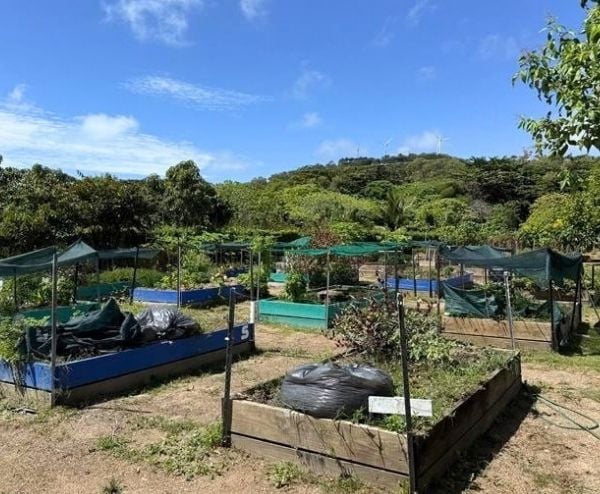
Local food production is a way to improve food security for remote communities in Queensland, by easing supply chain pressure, driving economic growth and local resilience.
Health and Wellbeing Queensland is addressing this through Gather + Grow, a program focused on improving food security in Far North Queensland and the Lower Gulf.
The challenge
Remote food security challenges sit at the intersection of food systems, health equity, governance, environmental health and economic sovereignty. Roundtable discussions that informed the Gather + Grow Strategy 2023–2032 (PDF, 2.9MB) identified a lack of culturally grounded decision making structures for determining appropriate and feasible local food production initiatives.
Under the Gather + Grow Action Plan 2023–2026 (PDF, 2.8MB) the Local Food Production Matrix has been developed. It provides a community led framework to support communities, government and partners during early stage decision making about food production initiatives in remote First Nations communities.
ASSESSMENT DOMAINS
Readiness Assessment Matrix
The Matrix is designed as a conversation and planning tool, supporting communities to have earlier and more informed conversations about local food production initiatives. The Matrix includes 7 domains with prompting questions, providing structure while still allowing flexibility, storytelling and culturally responsive ways of sharing knowledge.
During a collaborative planning process, stakeholders are guided to rate each domain along a 5-point readiness scale and record yarning notes in a workbook to document strengths, gaps, opportunities and risks.
1. Community readiness and participation
2. Practical feasibility
3. Cultural alignment and authority
4. Governance and responsibility
5. Food security and health contribution
6. Economic participation and skills
7. Environment fit and sustainability
ACKNOWLEDGEMENT
How the matrix was designed
The co-design of the matrix was led by Nirwarra Global, with guidance from a Steering Committee, Traditional Owners, Department of Primary Industries and Health and Wellbeing Queensland. Following an iterative design and development phase, the matrix was piloted in two remote Aboriginal communities. Traditional Owners from both communities endorsed the matrix and confirmed its alignment with community leadership principles.
The complete matrix (PDF, 2.3MB) and complementary workbook (Excel, 28KB) are available for all communities who may be considering local food production initiatives to use as part of initial planning processes.
Contact
For further questions about the Local Food Production Readiness Assessment Matrix, please contact hwqld_gathergrow@hw.qld.gov.au
SUBSCRIBE TO OUR NEWSLETTER
Insights and updates for the health and wellbeing sector
"*" indicates required fields