

Movement for the mind: How physical activity benefits your brain

Have you ever noticed feeling calmer or more focused after a walk? That’s not a coincidence, it’s your brain responding to movement in ways that can improve your mood, focus, sleep, and long-term health. Physical activity is not just important for your body. It plays a powerful role in how your brain feels, functions, and ages. In this article, we’ll explore what happens in your brain right after physical activity and longer-term, and simple ways to build more movement into your day for better wellbeing.
Why is physical activity good for the brain?
The human brain is a complex organ and largely relies on blood flow to provide essential nutrients and oxygen to function normally. Regular physical activity is one way to boost blood flow to the brain, supplying oxygen and nutrients needed to focus and learn. Physical activity also releases brain chemicals that help lift your mood and reduce stress. Over time, it supports the growth and connection of brain cells, helping you think more clearly and learn more effectively.
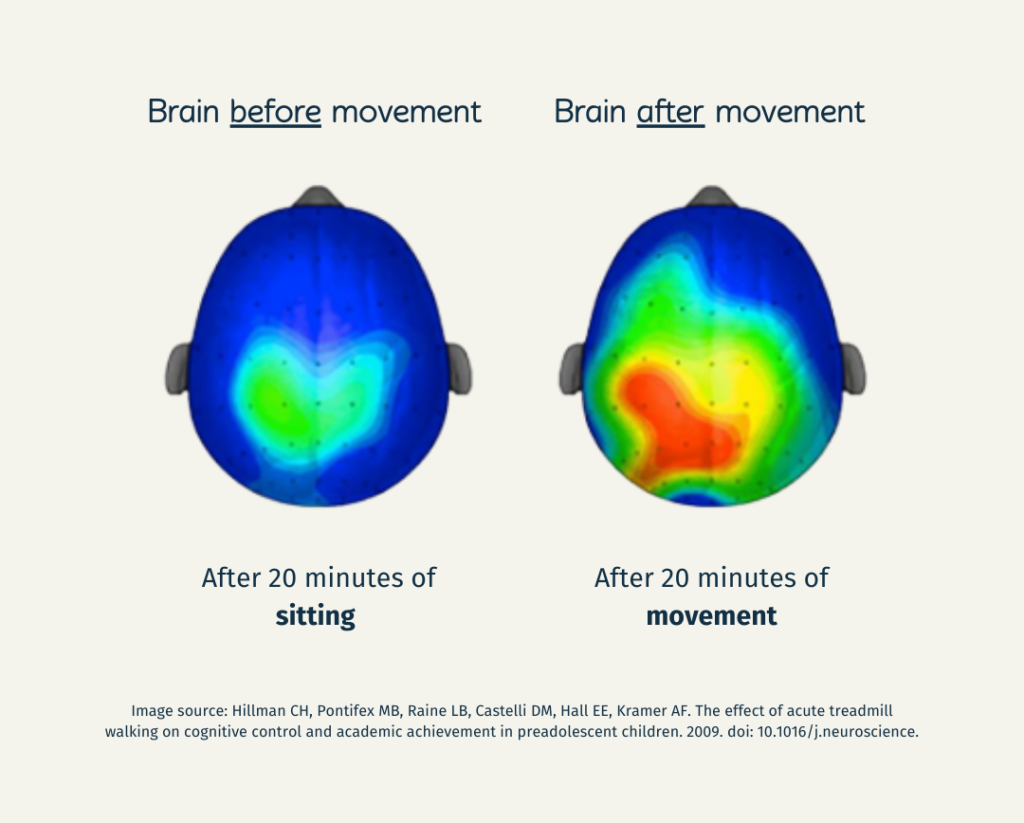
The effects of physical activity on the brain
Short-term effects
Physical activity can almost immediately change how we think and feel1. This might mean feeling more engaged in a meeting at work, being more present and able to play with your children, finding it easier to concentrate while studying, or being able to wind down at night after a long day.
During physical activity our brains release endorphins, dopamine and serotonin, also known as the ‘feel-good’ chemicals, which play a key role in improving our mood and helping regulate stress2.
Physical activity increases our alertness and concentration. Improved blood flow to the brain makes it easier to focus, process information and stay engaged in conversations and daily tasks. A study published in Neuroscience found that just 20-minutes of moderate intensity physical activity in children led to improved concentration and reaction time3.
Physical activity during the day can also improve sleep quality. Regular movement can help regulate the ‘body clock,’ making it easier to fall and stay asleep and increase mood and concentration for the next day.

Long-term effects
Sustained physical activity as we age is known to gradually shape how the brain is structured and adapts over time. It also reduces the risk of chronic disease, increases independence and memory.
A study published in the Lancet reported that long-term physical activity strengthens neuroplasticity – the brains ability to adapt4. In everyday terms, this means staying active can help you remember things more easily, solve problems faster, and stay independent as you get older. One study showed that these changes in the brain can happen in as little as 6 weeks.
People who are regularly physically active tend to show better memory, attention and executive functioning1 which are key for everyday life such as planning daily tasks, to maintaining independence and confidence in later life.
Physical activity is also linked to a reduced risk of neurodegenerative conditions, which are conditions where nerve cells in the brain or nervous system lose function over time, such as dementia and Alzheimer’s disease. While it does not eliminate risk, evidence suggests that staying physically active may slow cognitive decline and support healthier brain ageing. In this sense, movement acts as a form of prevention, strengthening the brain long before symptoms appear4,5.

How much physical activity should you do?
The Australian Government’s 24-hour movement guidelines recommend adults (18-64 years) should aim for at least 2.5 hours of moderate to vigorous intensity physical activities each week. That’s about 30 minutes on most days of the week.
Meanwhile, children and young people (5-17 years) are encouraged to do at least 1 hour each day of moderate to vigorous intensity physical activity that makes their heart beat faster6.
The good news is that these minutes don’t have to come from the gym or from just one type of activity alone — everyday activities all count. Common activities such as mowing the lawn, cleaning the house or going for a brisk walk or bike ride can benefit your brain and long-term health.
Tips to increase movement for better brain health
Focus on regular movement
Break up your sitting time with short bursts of movement throughout the day. Propose a walking meeting with your colleagues rather than sitting in a meeting room, take the stairs instead of the lift or escalator in public settings, or park at the back of the carpark and walk a bit further to the shops.
Enjoyment is key to sustainability
Choosing activities that you enjoy will ensure you remain active for years to come. What you enjoy might change over time, and that’s fine too! Here are 8 ideas on how to get moving, which might motivate you.
Be social
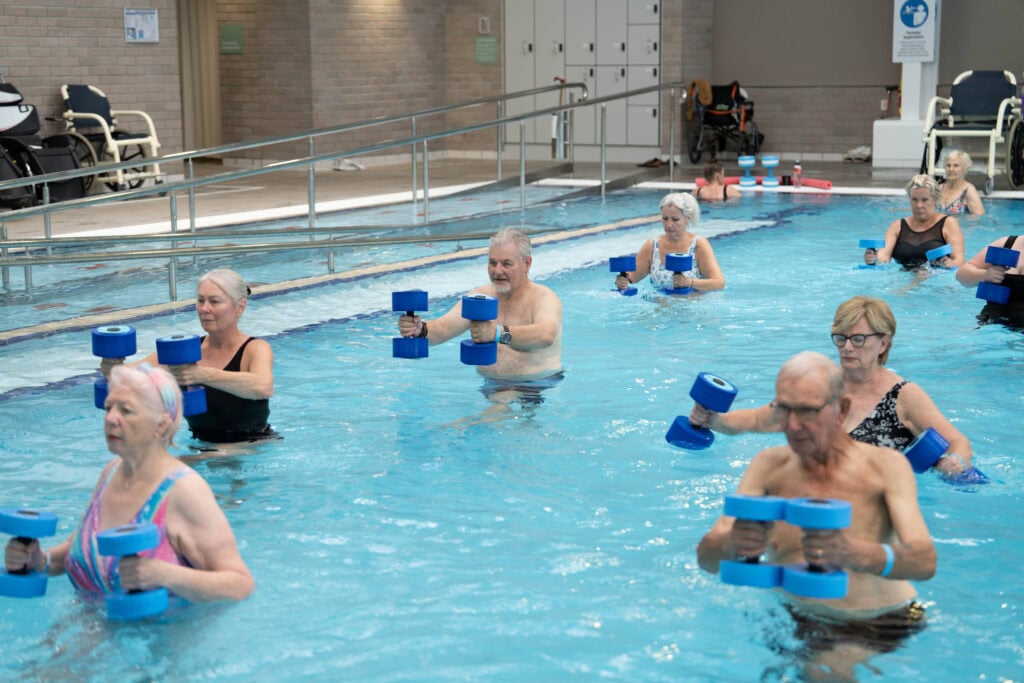
Invite a friend for a walk, or join a social sports club to boost your physical activity and social connection. If you need low impact options, then swimming, aqua aerobics or walking sports may be for you!
You don’t need a gym membership or a perfect routine to support your brain—just a little more movement, more often. Whether it’s a walk, a stretch at your desk, or playing outside with your kids, every opportunity to get active helps your brain feel better today and stay healthier for years to come.
Sources
- Garrett J, Chak C, Bullock T, Giesbrecht B. A systematic review and Bayesian meta-analysis provide evidence for an effect of acute physical activity on cognition in young adults. Commun Psychol [Internet]. 2024 Aug 28 [cited 2026 Jan 22];2(1):82. Available from: http://dx.doi.org/10.1038/s44271-024-00124-2
- Heijnen S, Hommel B, Kibele A, Colzato LS. Neuromodulation of aerobic exercise-A review. Front Psychol [Internet]. 2015 [cited 2026 Jan 22];6:1890. Available from: http://dx.doi.org/10.3389/fpsyg.2015.01890
- Hillman CH, Pontifex MB, Raine LB, Castelli DM, Hall EE, Kramer AF. The effect of acute treadmill walking on cognitive control and academic achievement in preadolescent children. Neuroscience [Internet]. 2009 Mar 31;159(3):1044–54. Available from: http://dx.doi.org/10.1016/j.neuroscience.2009.01.057
- Tari AR, Walker TL, Huuha AM, Sando SB, Wisloff U. Neuroprotective mechanisms of exercise and the importance of fitness for healthy brain ageing. Lancet [Internet]. 2025 Mar 29 [cited 2026 Jan 21];405(10484):1093–118. Available from: http://dx.doi.org/10.1016/S0140-6736(25)00184-9
- Iso-Markku P, Aaltonen S, Kujala UM, Halme H-L, Phipps D, Knittle K, et al. Physical activity and cognitive decline among older adults: A systematic review and meta-analysis: A systematic review and meta-analysis. JAMA Netw Open [Internet]. 2024 Feb 5 [cited 2026 Jan 21];7(2):e2354285. Available from: http://dx.doi.org/10.1001/jamanetworkopen.2023.54285
- Australian Government Department of Health, Disability and Ageing. 24-hour movement guidelines for all Australians [Internet]. 2026 [cited 2026 March 20]. Available from: https://www.health.gov.au/topics/physical-activity/24-hour-movement-guidelines-for-all-australians?language=en
Acknowledgement
Content developed in conjunction with Health and Wellbeing Centre for Research Innovation at The University of Queensland.
This blog post has been updated to reflect the Australian Government’s 24-hour movement guidelines.